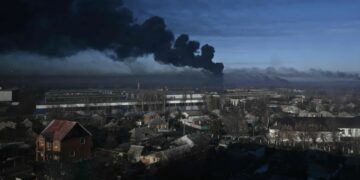

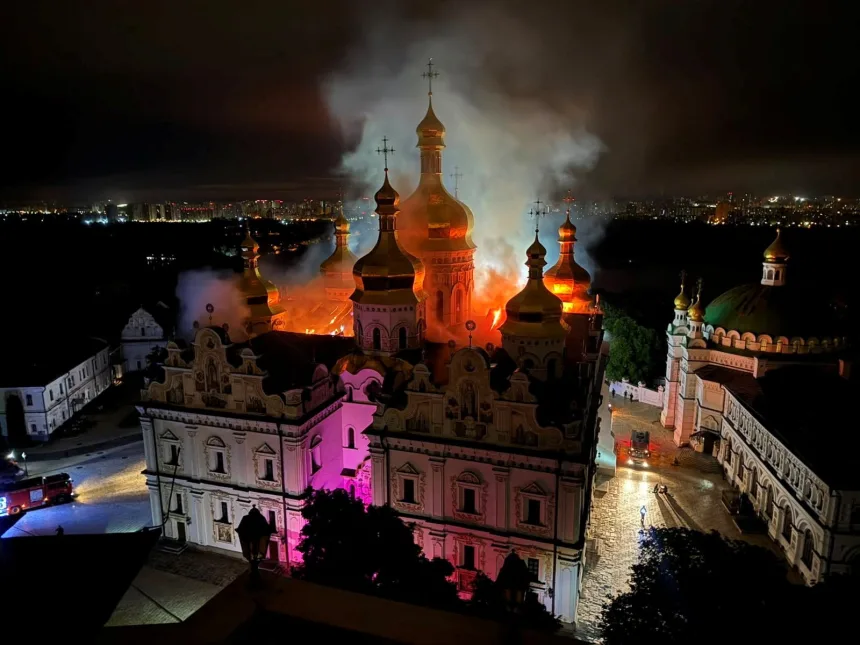
The reflections gathered here offer a poignant window into the hearts of Ukrainian students following the devastating Russian missile and drone attack on Kyiv during the night of June 15. The targeting of the Kyiv-Pechersk Lavra—a UNESCO-listed monastic complex with nearly a thousand years of history—transformed a routine night of military terror into a profound cultural tragedy.
Through these personal accounts, the students express a collective sense of heartbreak, anger, and deep emotional pain over the damage inflicted upon a vital symbol of Ukraine’s spiritual and national identity. Yet, amidst the terror of a “hellish night” and the smoky morning air, their voices do not reflect defeat. Instead, they highlight an unyielding spirit. These essays underscore a shared conviction that while buildings can be damaged, the tragedy will ultimately unite the Ukrainian people, strengthen their determination to protect their heritage, and draw critical international attention to the preservation of Ukraine’s irreplaceable history. What follows is a powerful testament to resilience, showing that even in the face of destruction, hope, and identity endure.
Vlada Hotovtseva:
Today’s attack on the Kyiv-Pechersk Lavra is a tragic event that caused not only physical damage but also emotional pain for many Ukrainians. I think the greatest loss is the damage to an important part of Ukraine’s cultural and historical heritage. The Lavra is not only a religious site but also a symbol of our history and national identity. Many people feel emotionally connected to this place, which makes the attack even more painful. Another serious disadvantage is the financial cost of restoration. Rebuilding and preserving historical monuments requires a great deal of time, effort, and money, and some elements of cultural heritage may be impossible to restore completely.
However, there may also be some positive consequences in the long term. This event could attract greater international attention to the importance of protecting Ukrainian cultural heritage. It may encourage international organizations, sponsors, and donors to provide financial support for restoration projects and heritage preservation. In addition, such events often unite people and strengthen their determination to protect their culture, history, and national identity.
Valeriia Bohdan:
I woke up feeling shocked and heartbroken after seeing the news about the Lavra. It is not just a building, it is a part of our history, culture, and identity. For centuries, it has stood as a symbol of Ukraine and our spiritual heritage. Seeing such a place damaged makes me feel sad, angry, and frustrated. It is painful to watch cultural landmarks suffer because of war.
At the same time, I believe this attack will only make Ukrainians stronger and more united. Every time something important to us is threatened, we become even more determined to protect it. The world will once again see what Ukraine is fighting for and why our culture and heritage matter so much.
I also think this event will draw more international attention to the destruction caused by the war and the need to preserve Ukraine’s historical and cultural sites. People around the world may better understand that this war is not only about territory but also about protecting our history and identity.
Buildings can be restored, but our spirit cannot be destroyed. The Lavra has survived many difficult periods throughout its long history, and I believe it will survive this one too. I hope that one day it will be fully rebuilt and become an even stronger symbol of Ukrainian resilience, strength, and hope for future generations.
Inna Pohrebniak:
During the night of June 15, Kyiv was subjected to a large-scale Russian missile and drone attack that caused destruction in the capital of Ukraine. Among the affected sites was the Kyiv Pechersk Lavra, a UNESCO-listed monastic complex with nearly a thousand years of history. Fires broke out in the monastery area, and emergency services worked under dangerous conditions to control the blaze near its historic structures, including the Dormition Cathedral. This event turned a military strike into a cultural tragedy, as both human lives and irreplaceable heritage were harmed.
For us, the damage to Kyiv Pechersk Lavra represents a profound loss of spiritual and historical identity. The Lavra is not only a religious center but also a symbol of continuity and cultural memory. Its destruction affects believers, local communities, and the broader international perception of cultural security during war.
The disadvantages are severe: potential irreversible damage to architectural heritage, psychological trauma for society, and increased cultural loss during an already destructive conflict. It also places additional pressure on emergency and restoration resources.
However, there are possible advantages for future generations. The event may strengthen international awareness of protecting cultural heritage in war and accelerate preservation of endangered sites. Reconstruction efforts can also foster global cooperation and result in more resilient restoration. Ultimately, this tragedy may deepen collective understanding of the value of heritage and strengthen long-term commitment to its protection.
Daria Shvydka:
Tonight Was Hell
This night was terrifying for every Ukrainian. Hundreds of drones and dozens of missiles were launched by the Russian Federation against peaceful Ukrainian cities. From the evening I felt anxiety building inside me, because I understood that a hellish night was approaching. I prepared a shelter for myself and my mother in the corridor, then lay down to sleep, waiting for the first strikes to begin.
Around 1 a.m., Kyiv’s air defense started working, and I went out to the shelter. I have a bad habit of monitoring the situation – tracking what’s flying and where – while what looks like a “Star Wars” battle unfolds outside the window. Around 2 a.m., information appeared about a strike on Ukraine’s oldest church, the Kyiv-Pechersk Lavra. That church was built centuries before the existence of what calls itself Russia. This is now the second time in history that the same despicable people have destroyed it.
I am not a deeply religious person – I only go to church on Easter — but inside me there was a pain as though my soul had been torn out. Right after the strike, a heavy rain began. And what is that? A sign that God exists? The weather helping to extinguish the aftermath of Russia’s atrocity? Or simply a coincidence? I don’t know. But I can say with certainty that I had goosebumps until morning.
Waking up after two hours of sleep, I walked to the window. Breathing in the smoky air, I gave thanks for this not-very-good, but Ukrainian morning.
Regardless of everything that has happened at the Lavra in recent years, a strike against a church is yet one more proof that Russia destroys everything.
Dina Kulynchenko:
Tonight was horrific to the extent that you are sitting in the shelter knowing that even that “safe parking” sometimes can’t save your life. We probably all were reflecting upon our lifetimes, recalling the most precious moments. This condition is underlined by tension in your chest that each minute can be the last one. I am convinced that Russians underwent and buried all moral principles and human rights. Their faith is death and sorrow. Regarding Lavra that was bombed, I feel speechless and hollow. It seems like something cracked inside. The national treasure is damaged. The place where a lot of people were praying to God, a lot of sacred images are located. It is a great sin. After a terrifying night, we might predict that we will never return to the concept of friendship; we were not siblings, we were not “a happy family,” and we will never be friends again. And I’m always recalling one inscription and conviction in my heart which is particularly one line from the famous Ukrainian song. “Though the suffering and destruction, through the bombing and the fear of evacuations, this revenge is felt at everybody’s fiber level. TO KILL OUR SOUL, YOU DO NOT HAVE SUCH CALIBERS.” by Yarmak “моя країна”. The pain is unendurable, but we firmly hold the map of the nation.
Zhenya Khashcha:
To hear the air alarm in the middle of the night feels different, but it always means the same: someone will die. And to leave the bomb shelter in the early morning with the first ray of sunlight feels different as well: tiring, exhausting, angrily, hopefully, but it always means that was not your last night. They are trying to eliminate people’s lives, hopes, and culture. And the rocket arrival to Kyiv-Pechersk Lavra is an example of it. And to the greatest symbolism, the sky was crying. As soon as the Lavra was in fire, it was raining in Kyiv at that time. Still, the night ends, and the sun is rising.
Polina Kostina:
The Russian attack on the Kyiv-Pechersk Lavra, a recognized UNESCO World Heritage Site, is yet another proof that culture cannot remain separate from politics. While the Russians promote their own writers and cultural figures, their compatriots are using their tax money to bomb our museums and historical sites. It pains me to think that some exhibits and historic buildings may never be restored due to the Russians’ constant attacks. However, despite the pain of the potential loss of cultural heritage, all that remains is to tell the world about it, so that these atrocities are not forgotten or downplayed by admirers of the Russian imperial legacy.
Alona Yakovenko:
Another Russian attack, another nightmare Ukrainians have had to experience. Today’s attack, however, reached the absolute peak of cynicism. Today, enemy rockets damaged one of the oldest historical landmarks of Kyiv—the Kyiv-Pechersk Lavra. Just the thought of it sends shivers down my spine, showing that even God himself seems unable to stop this horde from total destruction. One might wonder: ‘Why? Why did they do it?’. Unfortunately, this question is asked every single time they cross another line, and the answers still haven’t come. But here is one assumption: power. Yes, as primitive as they are, the likely reason is to flex their muscles at us: ‘Look, if we bomb a UNESCO church, what on Earth makes you think anything else can stop us?’. However, every coin has a flip side. Such a barbaric act proves to the whole world once again that we are not dealing with civilized people; on the contrary, every subsequent act like that buries the hope for a desirable peace deeper and deeper into the grave. Still, we’ve never stopped looking for the light. And this will be no exception.
Elizaveta Zavorotna:
The events of this night have stirred up a lot of mixed
emotions in me. The Lavra is an important landmark for the Ukrainian people and a symbol of the clergy. The recent attacks on it have filled me with both hatred and pain; it is a feeling of utter injustice. In the future, of course, the monument will be restored and it will become a symbol of resilience, but this will require a great deal of strength and endurance.
Anna Nazarenko:
Founded in the 11th century, comprising a complex network of surface and underground churches, the Lavra is a major spiritual and cultural center for Ukrainians, an important pilgrimage site, and is described by UNESCO as a “masterpiece of Ukrainian art.”
This is not a military target. Striking it serves no battlefield purpose. It is an act of cultural erasure – an attempt to wound not just bodies but identity and continuity. A 24-year-old theology student who came to pray at the site in the morning drew the parallel himself: “When Notre Dame burned in France, the whole world cried, people recorded videos, talked about what a tragedy it was.” The implication is clear and painful: some tragedies receive the world’s tears more readily than others.
Bishop Avraamii described watching flames rise from the window above the Dormition Cathedral, saying: “The Russians are not giving us any peace.” That quiet sentence carries enormous weight. It is not dramatic. It is exhausted. That exhaustion, after years of this, is itself a kind of damage that no restoration fund can repair.
For Ukraine’s cultural future, there is also a precedent worth noting: Notre Dame, after its fire, became a global cause. The world gave billions. Ukraine will likely see an outpouring of international commitment to preserving and restoring what was damaged and crucially, the vault of the Dormition Cathedral was preserved, meaning the structure was not lost entirely. Reconstruction is possible.
But perhaps the deepest consequence is symbolic and strategic. Russia, which claims to be defending Orthodox Christianity has now set fire to one of the holiest Orthodox sites in the world. Metropolitan Epiphanius, head of the Orthodox Church of Ukraine, wrote: “The roof of one of the holiest places in the Christian world the Assumption Cathedral of the Kyiv Pechersk Lavra is burning. This is what Moscow’s ‘Christian values’ look like.” That contradiction will echo in religious communities globally.
Tonight was a terrible night. But the vault held. And that matters not just structurally, but as a symbol. What has stood for nearly a thousand years is still standing. The task now is to make sure the world truly sees what was done here, and responds accordingly.