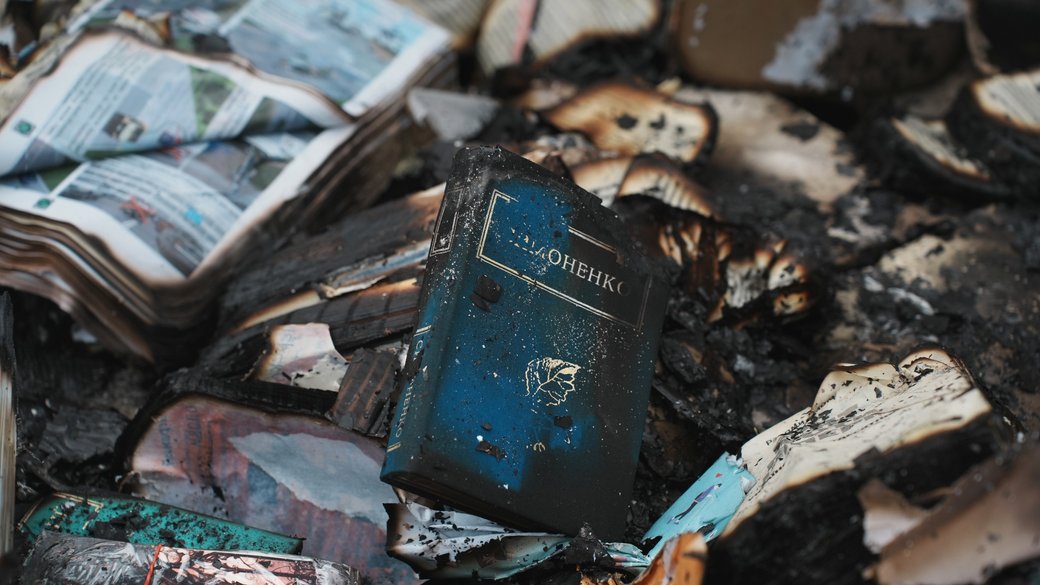
When an invading army expends precision missiles on book warehouses, printing presses, and school textbooks, it reveals that its primary objective is not merely territorial, but existential. Throughout Ukrainian history—from tsarist imperial edicts to Soviet repressions—occupiers have recognized that the printed word carries the bedrock of national memory, self-determination, and civic dignity. Today’s systematic strikes against publishing infrastructure constitute a modern front in that same long campaign of cultural erasure, designed to strip future generations of their native language and history.
Yet behind the ashes of destroyed printworks lies an unyielding refusal to be silenced. This collection brings together the perspectives of young Ukrainian voices who confront the reality of Russia’s cultural warfare firsthand. They analyze why literature poses such an acute threat to imperial narratives, document the devastation of educational materials, and bear witness to an indomitable publishing community that reprints every burned volume. These reflections testify to a fundamental truth: while paper burns, the ideas, sovereignty, and shared identity it anchors remain entirely indestructible.
Lisa Mkrtychian:
As a Ukrainian philology student, I have been particularly concerned about the destruction of Ukrainian books. Therefore, I have outlined four reasons why I believe Russia bombs Ukrainian books and publishing houses.
Russia wants to…
1…. make us believe that Ukrainian literature has nothing of value to offer.
For a long time, Russia has attempted to influence Ukrainian culture by promoting Russian-language literature while excluding Ukrainian books. This contributed to the belief that Ukrainian literature was inferior and lacked outstanding authors.
Today, however, Ukrainian authors are publishing remarkable books and gaining recognition. Ukrainians are also rediscovering classic authors whose works were diminished by Russian influence. Readers are realizing that Ukrainian literature is just as rich and compelling as that of any other country, including Russia.
2. … make us appear weak and inferior.
The destruction of books means fewer books, demoralized authors, and fewer new books published. Publishing houses are forced to rebuild after repeated attacks, while some have even had to close because they could no longer recover. Russia wants to demonstrate that Ukraine cannot develop without it. While promoting its own “great culture,” Russia attempts to destroy ours. Yet this only shows how threatened it is by our ability to preserve and develop our cultural identity.
3. … prevent Ukrainian educational books from being published while spreading its own propaganda.
Many of the destroyed books were educational materials intended for Ukrainian schools. Their destruction deprives children of access to education. In occupied territories, Russia also destroys Ukrainian-language books and replaces them with Russian ones that spread propaganda and impose a distorted version of history on Ukrainian children. In this way, Russia attempts to control what future generations learn and believe.
4…. spread its own culture while preventing us from sharing ours.
Russia has invested considerable resources in promoting its literature abroad, which is still widely regarded as intellectually significant, and reading Russian authors is often presented as a way to explore the depths of the mysterious “Russian soul.” This leads many people to seek deeper meaning in their actions and even show empathy toward the culture of murderers. Meanwhile, the destruction of Ukrainian publishing houses and books makes it increasingly difficult for us to share our literature with the world. Every destroyed book and interrupted publishing project becomes another obstacle to Ukrainian culture reaching international readers.
To conclude, by destroying Ukrainian books, Russia seeks to weaken our cultural identity, make us feel insignificant, spread propaganda, and portray its culture as superior.
Mariia Babulevych:
When Russians can’t reach you directly, they try to ruin something you value, something you hold dear. Naturally, they cannot destroy Ukrainian culture, just as they cannot destroy all books, for books would remain somewhere: in people’s homes, in libraries, in shops… However, every time you see a book on a shelf in your room, you’ll be forced to remember that the publishing house where it came from, its origin, has been destroyed. They cannot destroy everything, so they target the roots, the origins. I believe that this is precisely what they are trying to do with us Ukrainians as well: to make us forget where we came from, even if they can’t destroy us all.
Alisa Kurochkina:
Russia utterly targets Ukrainian publishing houses because books carry language, history, and identity. By destroying millions of textbooks, especially before the school year, Russia aims to disrupt education, damage everyday life and undermine the nation’s will to resist, demoralizing us all with the main symbol and tool in our everyday life. But the deeper purpose is cultural: to erase Ukrainian confidence and to make Ukraine seem unable to function effectively. I believe, this is cultural warfare and a violation of international humanitarian law. The fact that Ukrainian publishers keep printing new books is utterly bewildering act of defiance against this attempt at cultural violation; it enhances our desperation to fight over it and win.
Olha C.:
Russia has made a gruesome habit of bombing Ukrainian businesses as a means of terrorizing the population and damaging our economy. However, there is a deeper reason as to why the publishing houses in particular are targeted. Throughout history both the Russian Empire and then the USSR wanted to erase or assimilate colonized peoples by banning their languages, censoring books, killing authors, appropriating their culture, and rewriting history to serve propaganda. When Russia launched the full-scale war against Ukraine, all these methods remained, perhaps slightly changing their form.
Literature embodies the essence of its country of origin, showing its struggles, hopes, dreams, and worldview as a whole. And books are a physical manifestation of these ideas; therefore, they invoke fear and dread in the invaders. Moreover, provoking a crisis in Ukrainian publishing industry gives Russians an opportunity to say that Ukrainian culture isn’t as developed as theirs or doesn’t really exist.
By striking publishing houses responsible for publishing textbooks, an example being the “Ranok” warehouse, the Russians decrease the amount of educational materials. It creates additional problems for the learning process, as students already have to deal with constant air alerts and electricity outages.
Another reason is the absence of serious consequences for Russians from the rest of the world, as it reinforces the idea in their heads that they can get away with any atrocities. At this point they probably just don’t care whether they are hitting military targets, cultural sights, publishing houses, or civilians.
In conclusion, Russia tries to destroy as many publishers and their warehouses as it can because they are a key part of Ukrainian cultural identity, the education system, domestic market, and simply a part of the country they hate.
Maria Deshchenko:
There was a period in Ukrainian history, after we regained independence. This was a period when we didn’t have enough publishing houses and didn’t have an experience of publishing books in our native language, so for couple of decades we were reading mass literature from Russia. And that’s all it took to raise a couple of generations with russian propaganda in their heads.
Books are one of the greatest influences on people that can be. We need more emotional and intellectual capacity to read; that’s why we are mostly impacted by books that we read.
I believe that by massive attacks of publishing houses, they train to regain a control over our minds, over our forming way.
Kateryna Mazur:
This summer alone, Russia destroyed over 10 million Ukrainian books, which is comparable to the entire collection of the Bodleian Library at Oxford. Why do they do it? In my opinion, the key reason lies in the attempt to erase our identity. Books shape who we are. Through them, we develop our language, educate children in schools, and carry the shared narratives that unite us as a nation. For Russia, it is essential to weaken Ukraine culturally as well as physically. That is why they do not stop at targeting civilian infrastructure, but strike the very essence of our culture. If culture was not such a powerful foundation of our resistance, Russia would never invest so many resources into its destruction.
Karina Moshuk:
The targeted destruction of our print industry is an attempt to return Ukraine to its colonial roots. Just 7-10 years ago, the belief in the “backwardness” of our culture led many people to believe that any serious literature or best-selling books from around the world should be read in more “classy” and “higher” languages (their propaganda ensured that Ukrainians thought like that about the Russian language). However, with the rise of modern Ukrainian translations and independent publishers, we have shown the complete independence of our language and that we can truly engage with global ideas and thinking.
Russia is desperately trying to stop us by burning down our houses and publishing centers. This is an attempt to limit our independence in education and destroy any critical thinking. They cannot manipulate or control a generation who are knowledgeable and think critically in Ukrainian. The act of burning our books is an act of fear to our dignity which we refuse to return to a life of intellectual slavery.
On paper, a textbook is the least dangerous object in a war. It cannot be fired, jammed, or flown. Yet on 1 August a Russian strike on a Ranok warehouse in Kharkiv destroyed 8 million books, 600,000 of them school textbooks, and by the end of the month a printing house near Kyiv that had been turning out 1.3 million schoolbooks, about a tenth of the national total, was reduced to ash. Ukrainian publishers estimate that Russian strikes have destroyed about a third of the books printed in Ukraine this year. Unfortunately, this campaign did not begin in 2026. Back in May 2024, a missile hit the Factor Druk plant in Kharkiv and killed seven employees.
Kateryna Rudenko:
An invading army has reasons to care about a printing house or a warehouse of textbooks, because a textbook is where a state installs the frames through which a child will read the world: whose history this is, in which language it’s told, and who counts as a neighbour and who as an enemy. Moscow has long understood this strategy. It has pursued a cultural genocide in Ukraine for centuries, from the tsarist ban on Ukrainian-language publishing in 1876 to the Soviet purge of Ukrainian writers in the 1930s. The latest chapter came in December 2025, when it removed Ukrainian as a school subject from the federal standards applied in occupied territory, and russian books filled the shelves there.
So yes, a textbook cannot be fired, but its range is far longer than a missile’s. That is the reason to destroy it, and the reason to print it again.
Arsen Savenko:
Russia bombs and destroys our books because they serve as silent proof that we are a distinct nation with our own language, culture, and literary tradition. The very fact that the Russian military would launch a multi-million-dollar missile at a printing house that produces Ukrainian books, rather than at a military plant manufacturing artillery shells, clearly shows how threatening Ukrainian books are to Russia. In a war where Russia’s primary goal is to wipe our nation off the face of the earth, literature is one of the most crucial tools of propaganda. The first thing the occupation authorities did in the temporarily occupied territories was destroy Ukrainian literature and bring in Russian books. If Ukrainian literature ceases to exist, there will be nothing left to develop and promote the Ukrainian language.