

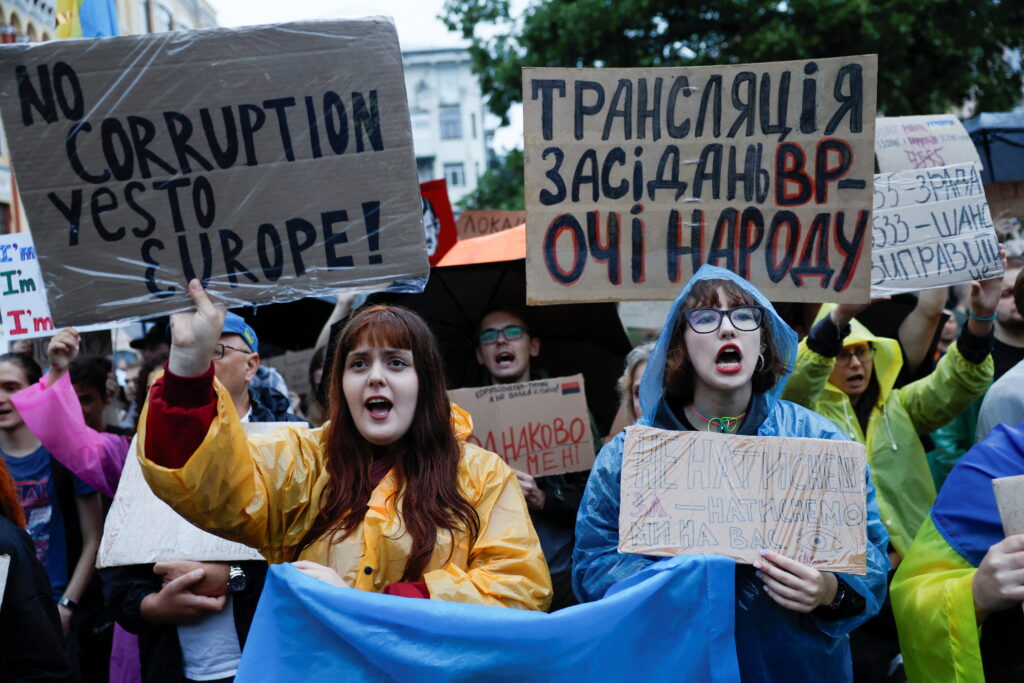
When tackling corruption and the future of Ukrainian society, the answers rarely lie in simple legal formulas or academic credentials alone. In this collection of reflections, students confront an uncomfortable truth: while education sharpens intellect and opens corridors to influence, it often fails to fortify the human will against greed. Degrees and prestige do little to suppress temptation when individuals attain power in an environment deprived of the fear of punishment; without genuine accountability, knowledge simply equips corrupt actors to maneuver around the law rather than respect it.
Some argue that real transformation demands strict personal values and an end to everyday ethical compromises, while others insist that even the most educated minds falter unless restrained by an impartial, unsparing legal system where consequences are inescapable. Still others contemplate historical cycles, political leadership, and the persistent civic duty to challenge the status quo.
Together, these voices navigate the delicate space between realism and conviction. They remind us that building a dignified society requires more than enlightened rhetoric—it demands a sustained, generational commitment to integrity backed by the certainty of justice.
Bohdan-Liubomyr Prytula:
Political power is a responsibility. But even the understanding of this responsibility, which education gives us, does not fully prevent corruption. Even well-educated politicians (Yermak, Mudra, Halushchenko) can get their hands dirty. That is why the root and the solution of the problem lie in a field of values. Only a society built on unshakable ethical principles is capable of combating corruption at all levels. In a democratic country, every person represents the state, so we should ask ourselves whether we’ve bribed the police or “bought” good grades. Common values are shaped by individual values and vice versa. That is the core of the system, and all changes must begin here.
Alisa Kurochkina:
The issue is complicated. On one hand, it is uncontrollable. In terms of system and political tradition, any brave aim may be more fanciful than reliable. On the other hand, after a long cycle of misery, a de Gaulle-like figure might change the situation. We cannot predict when the cycle ends, but we can hope—and act on that hope by fighting over the system, continuing it, and improving it.
This hope is not a plan, but it is not nothing. It sits between fatalism and fantasy, where action becomes possible. Systems crack and shift; a de Gaulle appears when legitimacy collapses. We cannot summon the moment, but we can prepare by thinking, organizing, and acting. We can only fight over the system’s meaning.
N.:
In a lesson we were wondering why people with good education (such as economics or law) can become unfair and corrupted. My answer was going to be simple: education or intelligence does not guarantee fair intentions on the government position.
Unfortunately, that even makes sense: individuals, striving to better life, gain better education, which leads to the leader chair, and here is a goal: they have access to power, finances, and security. If the decency of their leadership hasn’t been planned, the state has one more corrupted leader.
Among all the students of law/economics/political sciences/etc., only a few are willing to change the system and lead the state in some fair and selfless way. Actual attempts to get the power may even disappoint them, proving that the tradition is not easy to change.
As we see, fighting the corruption requires a lot of time, resources, and belief, that changes are possible. It’s also a matter of mentality: in a few generations that situation may change—only if we work towards changing it.
Mariia Babulevych:
Unfortunately, even the best and most prestigious education doesn’t guarantee a strong moral compass. In my opinion, we should instead begin by establishing a system that doesn’t allow those who are found guilty of corruption to avoid responsibility for their crimes.
Our goal should be to improve the law-enforcement system to make criminals face consequences for their actions and make punishment unavoidable. But of course, children should still be educated and raised to be decent and honest citizens, so that a genuine love for their homeland and a desire for change will be their motivations if they ever decide to pursue a career in politics.
Rostyslav Zenkov:
Preventing corruption in Ukraine should start from the bottom with everyday bribery in hospitals, workplaces, universities, and local offices. When people accept small corruption as normal, it creates a mindset that later leads to bigger corruption among ministers and officials. This means changing legislation so that even small acts of corruption have serious consequences, instead of just giving people fines that do not really stop them from doing it again. We can see a similar approach in countries like Singapore and South Korea, where courts use strict punishments to discourage corruption. At the same time, Ukraine needs education that teaches children from an early age to recognize and refuse corruption as a normal part of life. This helps bring a new generation of honest people into public service.
Lisa Mkrtychian:
At school, children must learn to respect and remember our past while remaining passionate about changing the future. That can be achieved by staying connected to our culture, history and language.
Everyone must try to understand one another’s pain, because it is harder to steal from or harm people with whom we share a deep connection. The educational system must teach empathy, compassion, and mutual support.
However, there will always be people who choose to do harm, and they must be held accountable for their actions. If a thief commits a crime and faces no consequences, they are more likely to continue breaking the law. Justice is essential to prevent corruption.
We have the power to shape history, and the key to it is unity. No matter how intelligent or capable a person may be, alone they remain vulnerable and fragile. But when we stand together, we possess a strength that no evil can overcome.
The children must learn to stay united, show respect and empathy, and share the same goals and beliefs. Moreover, we have to set an example for them. This way, we have the power to fight corruption and build the future of our dreams.
Kateryna Rudenko:
It seems to me that preventing corruption in Ukrainian society requires treating it as a systemic problem rather than a moral failing to be punished away.
Harsher penalties alone consistently fail to move the needle, and even the execution of corrupt officials has not led to an improvement in corruption perception indices. On the other hand, in countries such as the Netherlands and Finland, success in this area is achieved through transparency, institutional accountability, and a decline in social inequality.
As Italian economist Lucio Picci points out, those in power can use both corruption itself and campaigns against it as means of consolidating their control; Ukraine should therefore treat anti-corruption rhetoric that is not accompanied by real institutional changes with caution.
Ultimately, education plays no less an important role than institutional reforms: if children grow up seeing that honesty is rewarded, and corruption is exposed rather than accepted as the norm, dignity will become a living value for them. It is precisely this generational shift, more than any punishment, that will determine whether Ukraine can build a truly decent future.
Karina Moshuk:
Preventing corruption is a complex and lengthy process consisting of many steps, the very first of which is eliminating the gap between what we teach our children and how we act every day. We cannot simply tell children that corruption is wrong and move on, but also leave no room for doubt when they witness double standards: hearing that it is a crime, yet watching a parent slip 200 UAH to the family doctor to secure a referral to a specialist.
It is precisely from such petty, everyday corruption, masked as “that’s just how things are” or “it’s just a token of gratitude”, that society-wide tolerance of injustice begins. The state must fundamentally change the healthcare system by ensuring decent pay for medical workers and clear, transparent rules under state guarantee programs, so that no parent feels the need to buy attention or quality care for their child. At the same time, citizens must embrace their own responsibility: genuine gratitude is expressed through respect, kind words, and appreciation for the profession, not money slipped across the table under medical papers. Only when our children see rules applied consistently everywhere – from a local hospital appointment to the highest court rulings – will they develop authentic dignity and zero tolerance for bribery.
Anna Tsvirkun:
To build a decent future for Ukraine, in my opinion, we need to develop a culture of honesty, responsibility, and respect for the law, so that education and legislation would work together to prevent corruption in our society. Education should teach young people integrity and civic responsibility; while it cannot totally guarantee that people will always make the right choices, it will help in shaping a generation that values dignity and sees a better future for their country. At the same time, legislation must be clear, strict and provide for real penalties for corruption regardless of a person’s position or influence. Furthermore, government institutions must become much more transparent, and citizens should have effective ways to report corruption and protect themselves from retaliation. And, most importantly, society needs to stop treating corruption as something normal or unavoidable, because building a better Ukraine requires both strong institutions and people who are willing to uphold their principles in everyday life.
Daria Kulinich:
Unfortunately, every human society has corruption in its system. We only know about Ukrainian corruption problem because of media and prevalent stereotypes. among Western Europeans. Europe, USA, even countries that have the death penalty for this type of crime are still trying to wipe out unscrupulous citizens.
In my honest opinion, only education aimed at social responsibility can help with this type of problem. For example, Bohdan Havrylyshyn once made a “Declaration of Human Responsibility”, that contains different rules that we can use while teaching youth about responsibility. The same goes for ethics lessons and other subjects.
Liliia Polyvoda:
Unfortunately, corruption and the abusive use of power have become an everyday reality for us. These days, with eyes filled with tears and hearts filled with rage, we are all watching Operation ‘Carthage’ and wondering when we went off the right path and what we can do about it now. My view is that change begins with a change in mindset. We must stop defining corruption and bribery as a ‘Ukrainian national trait.’ For years, Kremlin-sponsored comedy projects have contributed to the prevalence of this view among our citizens. For years, they have been convincing us that a newborn Ukrainian knows how to steal gas and beg for money from economic giants, only to embezzle that money later. This did nothing to solve the problem; instead, it reinforced the idea that this is simply who we are and nothing can be done to change it. The idea that this is simply our nature. And so voters ended up voting not for a reformer, but for the person who would steal the least.
Skryabin sang, ‘You are a country unto yourself, so put your head in order.’ I cannot help but agree. Without a change in mindset, nothing will change.
Yulia Kushniruk:
First, we have to break our stereotypes that block our minds from accessing the situation clearly. Education is not the synonym for decency, and making general assumptions like that an educated person surely will have everyone’s best interests in mind is just not justified. Also, corruption is not only an issue for Ukraine but also for “more developed” nations as well; it’s just we hear about it less often. A person’s decency develops in early years by people who hold actual authority in their lives (like parents), so corruption psychology might often be generational if there isn’t any other more influential individual who instills better values. So, it might be incredibly difficult, but we have to try our hardest to “make the right people popular” and show our next generation that kind, generous, and sensible leaders are the ones to be admired and followed.
Natalia Laskevych:
If Ukraine wants to build a society based on dignity and low corruption, I think we have to stop relying on individual politicians. In my opinion, reliable systems work better than good intentions.
The most effective way to eliminate bribery is to remove the official’s power to demand one—I actually stole this idea from Kakha Bendukidze. Real anti-corruption reform focuses on stripping away that personal decision-making power. It requires, firstly, cutting unnecessary business permits; secondly, selling state-owned companies to private owners; and finally, moving public services online. When citizens can complete paperwork digitally without visiting an office or asking for a signature, the opportunity to pay a bribe disappears. European countries show that this works. For example, Estonia stopped everyday bribery by putting almost all government services online.
Yet, changing the law is only one part of the solution; the rest depends on education. As political journalist Vitaly Portnikov often notes, historically, many Ukrainians viewed the state as an outside power, and avoiding its rules was common practice. In my view, changing that attitude starts in schools and universities. When educational institutions tolerate plagiarism, bought exams, and fake diplomas, they teach students that rules are not real and that honesty has no value.
Ultimately, I think real change happens when each of us chooses honesty over a quick shortcut, so that the future we fight for is actually built on fair rules.
Olexandra Stetsenko:
I believe that preventing corruption requires a more critical and politically conscious society. In Ukraine, one of the first steps should be a more careful approach to electing political leaders and evaluating their previous actions, interests, and connections.
Education can contribute to this by developing critical thinking and political literacy rather than simply teaching us basic moral principles. At the same time, legislation should guarantee effective and proportionate punishment for corruption, regardless of a person’s position or influence.
Only when citizens make informed choices and corruption has real consequences can we create a system in which corruption becomes much harder to sustain.
Liliia Khomenko:
Corruption is a complicated problem, and there is not just one right solution. But in my opinion, to prevent its spreading, our education system should be based on the idea that everyone is equal. We need to build a society, where people don’t think they can outsmart the system and its bureaucracy with money. In that case, it won’t be a problem, or at least not a big one. But what we can do now, is to start by not accepting corruption in our daily lives. If we make it something that people should be ashamed of, it can actually work.
Maria Deshchenko:
The future of our country depends entirely on us, our capabilities, and our ambitions. In my opinion, education in Ukraine often relies on a post-Soviet approach toward students and stifles their ambition. You learn not to follow your passions and curiosity, but to adapt to a system that often demands dishonesty just for a higher grade, simply because it is more convenient that way.
It seems to me that if we adapted the school learning process into a discussion-based format where possible, and talked more often about why we are learning what we learn, students wouldn’t feel so deceived. In turn, they would also be more honest in how they express themselves. Open communication is essential in building any relationship, and a country is, first and foremost, a network of relationships built on agreements and trust. If we teach people how to communicate with each other properly, I am confident that Ukraine will have a bright future.
Mariia Khilinich:
I believe that education is one of the main driving forces behind our future, and it truly shapes it. But not in every case.
We can reform the education system a thousand times over, but it is unlikely to help solve the problem of corruption or other national issues.
We must understand that politics is, first and foremost, the responsibility of those who choose it as their profession. And, of course, an educated person must be aware of this responsibility. As we can see, this does not always work this way.
I do not believe that education directly influences this situation in our country, but I do not deny that it plays a role in shaping it.
Can we say that education has nothing to do with this when corruption still exists in educational institutions?
In the most prestigious diplomatic universities (where, for the most part, some of the most notorious corrupt officials studied), it is still possible to buy exam marks during exam periods.
And we can start by putting a stop to this minor ‘everyday’ corruption, which, in my view, is often the beginning of something bigger and leads to the situation we find ourselves in now.
There is no single real solution to this problem, or anything that can change the country in an instant. However, we have to start somewhere.